Safer Gambling at Prime Casino: Everything You Need to Know
Gambling, at its best, is a form of leisure — a way to enjoy a moment of excitement, explore a new slot title, or follow a live sporting event with an added stake. At Prime Casino, we take the position that genuine enjoyment of gambling depends on staying in control, and that staying in control requires access to honest, well-structured information. This page is that information.
We have put together this responsible gambling resource not because we are required to, but because we believe it matters. Gambling-related harm is real, it is widespread, and it can affect anyone — regardless of how experienced, financially stable, or psychologically resilient they consider themselves. Understanding the risks, and knowing where to turn when things become difficult, is the foundation of any healthy relationship with gambling.
The Principles Behind Responsible Gambling
Responsible gambling rests on a straightforward premise: gambling should serve you, not define you. When the time you spend gambling, the money you commit, and the emotional energy it consumes remain proportionate to its role as entertainment, it is within your control. When any of those factors begin to expand in ways you did not plan or cannot reverse, the balance has shifted.
The core principles that define responsible gambling practice include: gambling only with discretionary income that does not affect your essential financial obligations; treating every gambling session as a capped entertainment expense rather than an investment or income source; never gambling in pursuit of previous losses; and being willing to stop — and actually stopping — when your pre-set limits are reached.
These principles are easy to state but require active maintenance. The environments in which gambling takes place — whether online or physical — are carefully engineered to be engaging and immersive. Responsible gambling means choosing, in advance and in writing if necessary, the rules you will follow regardless of what happens during a session. It means treating those rules as non-negotiable rather than as suggestions.
Warning Signs: When Gambling Shifts from Recreation to Risk
Problem gambling rarely announces itself. It tends to develop gradually, with each individual escalation seeming minor in isolation. The challenge is that many of the early warning signs are easily rationalised or minimised, particularly by the person experiencing them. Awareness of these patterns is one of the most useful things anyone can develop.
The following indicators suggest that gambling behaviour may warrant closer attention or professional support:
- Spending more time thinking about gambling than you intend to — planning sessions, replaying losses, or anticipating wins during unrelated daily activities
- Increasing the size of your bets over time in order to feel the same level of engagement or excitement
- Feeling unable to stop or step away during a session, even when you planned to
- Returning to gamble shortly after a loss specifically because you want to recover the money you lost
- Concealing the extent of your gambling from people you are close to — partners, family, employers
- Gambling during periods of personal difficulty, emotional distress, or financial pressure
- Experiencing guilt, shame, or anxiety in the hours or days following a gambling session
- Taking money from savings, borrowing, or using credit to fund gambling activity
- Withdrawing from social activities, professional commitments, or personal relationships because of gambling
Identifying yourself in any of these patterns is not a reason for shame — it is a reason to seek support. These are recognised behavioural markers that respond well to early intervention, and the organisations listed throughout this page exist precisely to help at every stage.
How Gambling Myths Skew Our Decision-Making
A remarkable number of harmful gambling decisions are made on the basis of beliefs that are demonstrably false. These myths are culturally embedded, frequently reinforced by anecdote, and often feel intuitively correct — which makes them particularly difficult to challenge without clear information.
The gambler’s fallacy. The belief that after a sequence of identical outcomes — several reds in roulette, for example — the opposite outcome becomes statistically overdue. In reality, each event in a game of chance is independent. No prior result influences the next one. Random number generators do not have memory.
Betting systems create an edge. Systems such as the Martingale — doubling your stake after each loss — are mathematically incapable of overcoming a house edge. They redistribute when you win and when you lose, but they do not change the fundamental odds. In the long run, the house advantage remains constant regardless of how sophisticated your staking strategy is.
Near misses mean you were close to winning. Slot machines are designed to produce near-miss outcomes with high frequency. Research consistently shows that near misses activate the same reward pathways in the brain as actual wins, encouraging continued play. A near miss is not evidence of proximity to a win — it is a loss that was engineered to feel different.
Experienced gamblers lose less. Familiarity with games does not reduce the house edge. In games that are primarily luck-based, extended play increases cumulative losses, regardless of experience level. Confidence derived from experience can, paradoxically, increase the risk of larger losses.
The Emotional and Financial Toll of Gambling Addiction
The harm caused by gambling disorder extends far beyond a depleted bank account. Financial damage is often the most visible consequence — unsecured debt, missed payments, depleted savings, or borrowed money that cannot be repaid — but it is rarely the deepest one. The psychological and relational damage tends to outlast financial recovery and requires dedicated, sustained attention to address.
Emotionally, people experiencing gambling disorder frequently report a persistent cycle of shame, relief, and despair. The shame of having gambled — particularly when it was against their own intentions — triggers emotional distress. That distress is temporarily relieved by the next gambling session, which then produces further shame. This cycle can persist for years without the person ever recognising it as the mechanism driving their behaviour.
Relationships carry an enormous weight in problem gambling. Partners who discover hidden debts, parents who find money missing, employers who notice unexplained absences — the secondary impact of one person’s gambling disorder can cause lasting damage to a wide circle of people. Children in households where a parent has a gambling problem are particularly vulnerable to long-term psychological effects, including heightened risk of developing their own problematic relationship with gambling in adulthood.
A Visual Snapshot: Where Gambling Harm Shows Up
The chart below illustrates the most commonly reported areas of life that are negatively affected by problem gambling, based on patterns identified across UK support services. It is intended to provide a clear picture of how wide-ranging gambling harm can be — and why a comprehensive support framework matters.
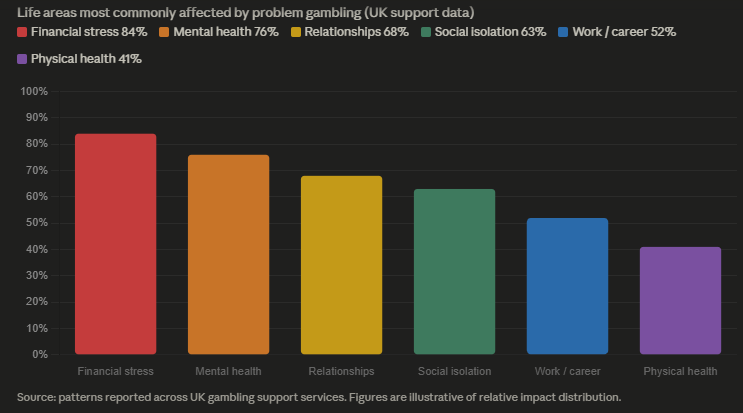
No single area operates in isolation — financial difficulties amplify mental health strain, which worsens relationships, which increases the impulse to gamble as an escape. Understanding this interconnected picture is important both for individuals and for the people around them.
Taking Control of Your Finances Before You Gamble
Financial discipline is the single most practical safeguard available to recreational gamblers. It requires deliberate planning before each session and honest accounting after it. The following framework is a useful starting point for anyone who wants to gamble without exposing their financial stability to significant risk.
- Define your total monthly gambling allowance. This should be a fixed percentage of your post-tax, post-essential-expenditure income — not a figure arrived at spontaneously. Write it down and treat it as binding.
- Divide the monthly allowance into session amounts. Decide how many sessions you will have and how much each will carry. Never treat unspent session funds as a reason to extend a different session.
- Use a dedicated payment method. A prepaid card or a secondary current account loaded only with your gambling allowance creates a hard ceiling that is difficult to breach accidentally.
- Record every session outcome. Win, loss, duration, and emotional state. Over several months, this record will give you an honest picture of your gambling that you simply cannot construct from memory alone.
- Review quarterly. Are your actual losses matching your planned allowance? Are sessions running longer than intended? Is gambling affecting your mood outside sessions? These questions deserve honest answers.
| Situation | Safer Response | Risky Response |
|---|---|---|
| Session budget is spent | End the session immediately | Top up with additional funds |
| You are on a winning streak | Cash out a portion; keep playing with a defined amount | Increase stakes; assume the streak will continue |
| You have just suffered a significant loss | Take a break; revisit in a different emotional state | Continue immediately to recover the loss |
| You are feeling stressed or anxious | Postpone the session entirely | Use gambling as a distraction or emotional relief |
| Monthly allowance is exhausted mid-month | Stop gambling until the following month’s allowance begins | Borrow or access savings to continue |
Practical Habits That Support Long-Term Safer Gambling
Beyond financial controls, safer gambling is supported by a range of behavioural habits that reduce both the risk of harm and the psychological conditions that make problem gambling more likely to develop. These are not one-off actions — they are ongoing practices that require consistent attention.
Gambling should always compete with other leisure activities rather than replace them. When gambling is the primary source of entertainment, excitement, or social connection in someone’s life, the psychological stakes of any given session become artificially elevated. Maintaining a range of genuinely satisfying activities outside gambling — physical, creative, social — provides the context in which gambling can remain proportionate.
Time limits are just as important as money limits. Set an alarm before you start and commit to stopping when it sounds. Many operators offer session time reminders and cooling-off periods — use them. Fatigue and extended play are closely associated with the kinds of impulsive decisions that lead to overspending.
Never gamble under the influence of alcohol or other substances. Impaired judgement is one of the most consistent predictors of in-session overspending and post-session regret. If you are drinking, it is not the right time to gamble.
Blocking Your Own Access: Self-Exclusion Across the UK
Self-exclusion is a formal, binding mechanism that prevents you from accessing gambling services for a defined period. In the UK, the most comprehensive tool for online gambling is GAMSTOP — a free national scheme that registers your details and applies exclusions across all UK Gambling Commission licensed online operators simultaneously. Once registered, the exclusion cannot be reversed before the minimum period expires, which is deliberately designed to provide a meaningful pause rather than a momentary barrier.
GAMSTOP exclusions are available for six months, one year, or five years. The scheme covers online casinos, sports betting, poker sites, and bingo platforms that hold UK licences. It does not cover land-based venues or operators without UK licensing — for those, exclusion must be applied directly with each venue or through local schemes coordinated by councils and operators.
Self-exclusion is most effective when treated as the first step in a broader strategy rather than a complete solution. Combining GAMSTOP registration with personal support, blocking software, and bank-level transaction controls provides a substantially stronger safety net than any single measure alone.
Software That Blocks Gambling at the Device Level
Even with national self-exclusion active, online gambling remains technically accessible through unlicensed sites and alternative devices. Gambling blocking software addresses this by operating independently of operator compliance, making gambling content inaccessible at the device or network level regardless of how access is attempted.
The most widely used tools available to UK users are:
- Gamban — Installs across multiple devices including smartphones, tablets, and computers. Blocks thousands of gambling websites and applications. A subscription covers up to five devices and is difficult for the user to remove unilaterally during the coverage period.
- BetBlocker — A no-cost tool run by a registered charity. Blocks access to gambling domains and can be configured to make removal require a delay of up to five years.
- NetNanny — Primarily a parental control solution but widely used by adults who want category-level gambling blocks applied across all users on a shared device.
Installing blocking software on every device you own — and asking a trusted person to manage the administrator password — substantially reduces the ease with which exclusion commitments can be circumvented during a moment of weakness.
UK Bank Gambling Blocks: A Two-Minute Safeguard
Most UK high street and digital banks now allow customers to apply a gambling transaction block directly through their banking app or by calling their provider. When active, this block prevents your debit card or bank transfer from being processed at gambling merchants — including online casinos, betting sites, and poker rooms. The block does not affect other spending and can typically be activated within minutes.
This tool is particularly valuable because it creates a financial barrier that operates independently of willpower. A decision made in advance — to block gambling transactions — holds even when your in-the-moment impulse to gamble is strong.
| Bank | How to Activate the Gambling Block |
|---|---|
| Barclays | Barclays app → Card Controls → Gambling toggle |
| Lloyds / Halifax | Internet banking or via customer services |
| NatWest / RBS | NatWest app → My Spending → Gambling controls |
| Monzo | App → Account → Gambling block (instant toggle) |
| Starling Bank | App → Spending → Gambling block |
| HSBC | Branch, phone, or online banking request |
| Revolut | App → Security → Merchant controls → Gambling |
Note that bank gambling blocks apply to card and bank transfer payments. They do not prevent cash withdrawals, which can still be used at physical betting shops. For comprehensive protection, combine the bank block with GAMSTOP registration and device-level blocking software.
Gambling, Emotional Wellbeing, and the Escape Trap
One of the least discussed — but most clinically significant — aspects of gambling disorder is its role as an emotional regulation tool. Many people who develop serious gambling problems began using gambling not primarily for the thrill of winning, but as a reliable and immediate way to escape difficult feelings. Loneliness, boredom, anxiety, grief, and low self-worth are among the most common emotional drivers that shift gambling from entertainment to compulsion.
The problem with using gambling to manage emotions is that it works — temporarily. The focused attention required during a gambling session can genuinely quieten intrusive thoughts and provide brief relief from emotional pain. But the relief does not last, and the gambling session typically ends with additional stress: financial loss, time wasted, commitments unfulfilled. This creates a new emotional burden, which then motivates another session. Recognising this pattern in yourself is a significant and courageous step.
Developing alternative emotional regulation strategies — physical exercise, social contact, creative activity, mindfulness practices, or professional counselling — does not happen overnight. It requires support. If your gambling has an emotional component, please consider speaking with a specialist. The services listed in the professional support section below are experienced in exactly this kind of work, and most are available at no cost.
Protecting Children and Vulnerable People from Gambling Harm
UK law prohibits gambling by anyone under the age of 18. Our platform does not create content directed at minors and does not promote gambling services in ways that could appeal to young people. However, in households where devices are shared, additional steps are important.
Parental controls at the device and network level can prevent younger household members from accessing gambling websites even if they find their way to a search engine independently. GamBlock offers persistent device-level blocking that applies across user accounts and cannot be easily bypassed. For broader household content controls, network-level filtering through your broadband provider is worth exploring.
Vulnerability is not limited to age. Adults experiencing acute mental health difficulties, bereavement, financial crisis, or substance dependency face elevated risk of gambling-related harm even if they have previously engaged with gambling without problems. The BigDeal service provides specialist support for young people up to the age of 25 who may be showing signs of gambling-related harm, including those in transition to adulthood who are less likely to seek help through mainstream channels.
Support for the People Around You
Gambling addiction is frequently described as a family disease, because its consequences do not stop at the individual. Partners who have experienced the discovery of hidden gambling debts describe it as a profound betrayal of trust. Parents who have watched a child’s life narrow around gambling feel helpless. Friends who have lent money that was never returned carry their own complicated emotional aftermath.
If someone close to you is struggling with gambling, it is important to understand that you cannot force change — but you can protect yourself and maintain your own boundaries clearly and consistently. Covering gambling debts typically prolongs the harm rather than resolving it. Enabling continued access to funds, or making excuses on someone else’s behalf, delays the moment at which they must confront the full consequences of their behaviour.
Dedicated support for affected friends and family is available through several organisations, each of which understands the particular dynamics of loving someone with a gambling problem:
- Gamblers Anonymous UK — Operates Gam-Anon, a parallel peer support programme designed specifically for partners, family members, and close friends. Meetings take place across the UK both in person and online.
- Gambling Therapy — Provides free online counselling, one-to-one support, and dedicated forums for people affected by someone else’s gambling — regardless of whether the gambler themselves is engaging with help.
Where to Get Professional Gambling Support in the UK
The UK has a well-resourced network of professional support services for people affected by gambling harm. These range from free national helplines and peer support groups through to specialist NHS clinical treatment and residential recovery programmes. No matter how severe or how recent the problem, there is a service designed for your situation.
Helplines, counselling, and online support:
- BeGambleAware — Funds and operates the National Gambling Helpline in partnership with GamCare. Available 24 hours a day on 0808 8020 133 (free). Also provides self-assessment tools, live chat, and a searchable directory of local services.
- GamCare — Delivers the National Gambling Helpline and provides free structured counselling, online therapy, and community support forums. One of the most accessible entry points for anyone seeking gambling support in the UK.
Specialist NHS and clinical services:
- National Problem Gambling Clinic — England’s first NHS specialist clinic, providing comprehensive psychiatric and psychological assessment and treatment for adults with gambling disorder.
- NHS Northern Gambling Service — Free specialist gambling treatment for adults across the North of England, available in person and remotely.
- NHS Southern Gambling Service — Free NHS treatment for adults in the South of England experiencing gambling-related harm.
- West Midlands Gambling Harm Clinic — Provides assessment, individual therapy, and group support for adults in the Midlands region.
Residential and intensive treatment:
- Gordon Moody — Provides residential treatment programmes for individuals with severe gambling addiction, along with therapeutic community support and a remote recovery pathway. Widely regarded as the most intensive specialist service available in the UK.
Emergency and Crisis Support
If gambling-related distress has reached a point of crisis — whether that means acute financial emergency, thoughts of self-harm, or a mental health breakdown — please seek help immediately. You do not need to wait until the situation is worse, and you do not need to have a plan before you make the first call.
- Samaritans — Free, confidential listening support available 24 hours a day on 116 123. For anyone experiencing emotional distress, overwhelm, or thoughts of suicide.
- National Gambling Helpline — 0808 8020 133 — Free, 24/7, specifically for gambling-related crisis and distress.
- NHS 111 — For urgent (but non-emergency) medical or mental health needs. Available around the clock.
- 999 — Emergency services for any situation involving immediate risk to life.
Reaching out in a moment of crisis is not a sign of weakness. It is the most rational response to a situation that has become unmanageable alone. Please do not wait.
About Our Platform: Affiliate Disclosure and Editorial Independence
Our website publishes reviews of online casinos, bonuses, slot games, payment methods, and gambling guides for adult audiences in the United Kingdom. Some of the links within our content are affiliate links — meaning we may earn a commission when a reader registers with an operator we have reviewed. This financial arrangement does not influence our editorial assessments, our responsible gambling content, or the information on this page.
We are not a gambling operator. We do not accept player funds, host games, or process wagers. Our role is informational: to help adults make more considered decisions about where and how they gamble online. All content published on our platform is intended for adults aged 18 and over. You can learn more about who we are and how we operate on our About page.
Our Privacy Policy sets out how we collect and handle any data associated with your use of this site. For answers to common questions about our content, our methodology, and our approach to responsible gambling, visit our FAQ page.
Questions We Hear Most Often About Safer Gambling
Can recreational gambling ever become harmful without warning?
Yes, and this is one of the most important things to understand. The transition from recreational to harmful gambling is rarely marked by a single dramatic event. It accumulates through small escalations — slightly longer sessions, slightly larger bets, slightly more frequent play — until a pattern is established that is difficult to interrupt. This is why proactive habit-setting matters even when everything feels fine.
Is GAMSTOP permanent? What happens when the exclusion period ends?
GAMSTOP exclusions are not permanent by default. They are available for six months, one year, or five years, and they cannot be reversed before the minimum period expires. When the exclusion ends, access to licensed sites is restored. However, the scheme does allow you to extend your exclusion at any point. Many people choose to do so, having found that the pause gave them time to address underlying issues and establish genuinely healthier habits.
What if I want to gamble but I’m not sure whether I have a problem?
Uncertainty itself can be a useful signal. BeGambleAware and GamCare both offer free, anonymous self-assessment tools that can help you evaluate your relationship with gambling more objectively. These assessments are not diagnostic, but they provide a structured way to reflect on your behaviour that is more reliable than informal self-assessment alone.
My partner gambles and is in denial. What can I do?
This is one of the most painful positions to be in. You cannot force someone to acknowledge a problem or seek help before they are ready to do so. What you can do is protect your own finances, set clear limits on what you are willing to fund or enable, seek support for yourself through Gam-Anon or Gambling Therapy, and continue to express your concern from a place of care rather than accusation. In some cases, professional family counselling can also be helpful.
Do all UK banks offer gambling transaction blocks?
Most major UK banks and challenger banks now offer this feature, though the process for activating it varies by provider. The majority can be activated through a mobile banking app within minutes. If your bank is not listed in our table above, we recommend checking their app settings directly or contacting their customer service team — the feature has been introduced by most providers in recent years.
Are gambling support services confidential?
Yes. All of the specialist gambling support organisations listed on this page operate under strict confidentiality principles. Calling the National Gambling Helpline, accessing online counselling through GamCare, or attending a Gamblers Anonymous meeting does not result in any record being shared with your employer, family, or other agencies without your explicit consent. Your decision to seek help remains yours.
Is this website responsible for the casinos it reviews?
No. Our platform publishes independent editorial reviews and comparison content. We are not a licensing authority, a regulator, or a guarantor of any operator’s conduct. All operators featured in our reviews must hold a valid UK Gambling Commission licence, but we cannot be held responsible for the practices of individual operators. If you have a complaint about a licensed UK operator, the appropriate route is through the operator’s complaints process and, if unresolved, through an approved Alternative Dispute Resolution service.
Contact Us
If you have a question about the content on this page, a concern about how our platform handles responsible gambling topics, or a request related to our editorial policies, please get in touch. We welcome all correspondence related to safer gambling and aim to respond within two working days.
- Email: [email protected]
- Contact page: primecasinouk1.com/contact/
For responsible gambling enquiries, legal correspondence, or formal written communications regarding this platform’s safer gambling obligations, please use the email address above and indicate the nature of your enquiry in the subject line. We do not provide crisis support — if you or someone you know needs immediate help, please contact the services listed in the emergency section above.